
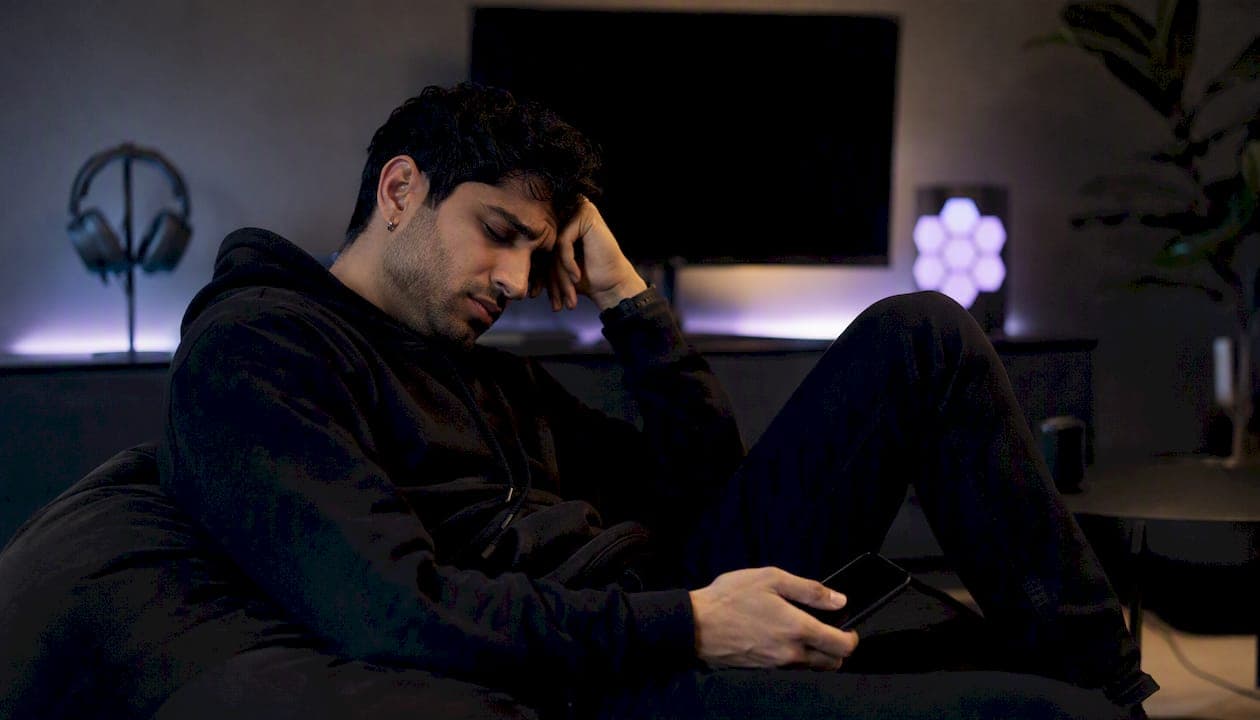
Dating app burnout is the emotional and mental exhaustion that builds up from swiping, matching, and messaging on repeat without real payoff. If you're in it right now, the fastest relief is boring but effective: schedule a real break, even 48 hours, and set a hard time limit for every session you allow yourself after that. Both work because they interrupt decision fatigue, the mental drain of sorting through dozens of strangers and micro-choices with no clear finish line.
- Step one: Delete the apps from your home screen or log out for 2 to 7 days. No half-measures.
- Step two: When you return, cap sessions at 10 to 15 minutes and set a weekly limit on how many times you open the app at all.
Pro Tip: Turn off notifications before you take your break, not after. Notifications are the thing pulling you back in, not willpower failure.
Key Takeaways
Dating app burnout comes from a predictable mix of decision fatigue, gamified design, and isolation, and it recovers fastest through structured breaks, time limits, and shared-activity dating formats.
| Point | Details |
|---|---|
| Take a real break first | Log out for 2 to 7 days before attempting any other fix; this interrupts decision fatigue immediately. |
| Recognize the three sign clusters | Watch for emotional numbness, compulsive checking behavior, and cognitive beliefs like "nothing works." |
| Understand the mechanism, not just the mood | Gamification, snap-judgment swipe design, and isolation combine to produce a well-documented burnout cycle. |
| Cap sessions and frequency | Time-box each session to 15 minutes and set a weekly limit before reentering apps. |
| Consider activity-based matching | Apps like Midnight Lobby use DuoFit compatibility and in-chat icebreaker games to reduce superficial swiping and ease first conversations. |
Table of Contents
- What Are the Signs of Dating App Burnout?
- Why Dating Apps Drain You: Decision Fatigue, Gamification, and Isolation
- How Common Is Dating App Fatigue Right Now?
- How Do You Break the Dating App Burnout Cycle?
- How Do You Return to Dating Apps Without Burning Out Again?
- When Should You Get Professional Help for Dating App Fatigue?
- A Human Perspective on Dating App Burnout
- A Different Way to Meet People When Swiping Feels Exhausting
- Frequently Asked Questions
- Sources
What Are the Signs of Dating App Burnout?
Burnout doesn't always look like tears and a dramatic app-store deletion. Usually it looks like numbness. You're swiping through faces and barely registering them, or you feel a flicker of dread when a notification pops up instead of curiosity.
The signs tend to cluster into three categories:
- Emotional: irritability toward matches, dread before opening the app, a flat lack of interest in dates you'd normally be excited about.
- Behavioral: compulsive checking between meetings, swiping for the sake of swiping, rage-deleting the app only to redownload it three days later.
- Cognitive: decision fatigue, a nagging sense that you're disposable to everyone you match with, and the belief that "nothing works" no matter what you try.
Clinicians who work with dating clients report this pattern constantly. AP News found that roughly three out of four therapy clients who use dating apps report fatigue at some point, which tells you this isn't a personal failing. It's a predictable response to the format.
Run a quick self-check: Have you matched with someone this week and felt relief instead of excitement when the conversation fizzled? Have you swiped through 20 profiles without reading a single bio? Have you canceled a date because messaging felt like a chore? Two or more "yes" answers mean you're likely past tired and into burned out.
Why Dating Apps Drain You: Decision Fatigue, Gamification, and Isolation
Burnout isn't random. It's the predictable output of a specific mix of human psychology and product design that most people never think to question.
Start with decision fatigue. Every profile asks your brain to run a mini evaluation: attractive or not, compatible or not, worth a message or not, hundreds of times per session. Cleveland Clinic psychologist Susan Albers describes online dating as work for the brain, a form of heavy cognitive sorting that produces overwhelm and paralysis when it never lets up.
Layer gamification on top of that. Matches, likes, and streaks work the same intermittent reward system as a slot machine, so your brain keeps pulling the lever even when the results feel empty. Swipe mechanics compound the problem: journalist and researcher coverage cites relationship expert Jenny Taitz's observation that swiping primes snap judgments that make people feel disposable, turning potential partners into a stream of yes-or-no decisions instead of people.
- Decision fatigue from constant sorting and micro-choices
- Slot-machine style rewards that keep you swiping past the point of interest
- Swipe-first design that trains snap judgment over-curiosity
- Isolation, since most of this happens alone, late at night, with no one to reality-check the spiral
Communication researcher L.L. Sharabi notes that burnout thrives in isolation, and that social support helps interrupt the downward pull. Searching for a partner is already vulnerable work. Doing it entirely solo, with an app optimized to keep you scrolling, is a recipe for exhaustion.
How Common Is Dating App Fatigue Right Now?
The scale here is bigger than most people assume. A Forbes Health survey found that a large share of younger users report feeling burned out by dating apps. That's not a niche complaint. That's a majority experience among Millennials and Gen Z users.
A BBC Future feature aggregating many years of research covering a large population found that dating app users report worse psychological outcomes, including higher depression, anxiety, and loneliness, than non-users(https://www.bbc.com/future/article/20260526-its-not-just-you-dating-apps-have-a-burnout-problem). The piece names gamification, hidden emotional labor, and the sheer abundance of choice as the core drivers.
Peer-reviewed work backs this up in clinical terms. Research hosted on PMC connects problematic digital dating use to measurable negative mental-health outcomes, which is part of why clinicians increasingly treat app fatigue as a legitimate topic in therapy rather than a throwaway complaint. Pew Research had already documented the broader shift toward digital platforms reshaping how people date years before burnout became a headline, which suggests the strain was building long before anyone had a name for it.
A predictable burnout cycle emerges from gamification, hidden labor, and an overwhelming volume of choice, not from any one bad match or bad week.
How Do You Break the Dating App Burnout Cycle?
Recovery isn't about willpower. It's about restructuring how you use the apps so the same triggers stop firing.
- Time-box every session. Fifteen minutes, hard stop. Use your phone's timer, not the app's built-in one.
- Cap your weekly frequency. Two to three sessions a week is plenty. More than that and you slide back into compulsive checking.
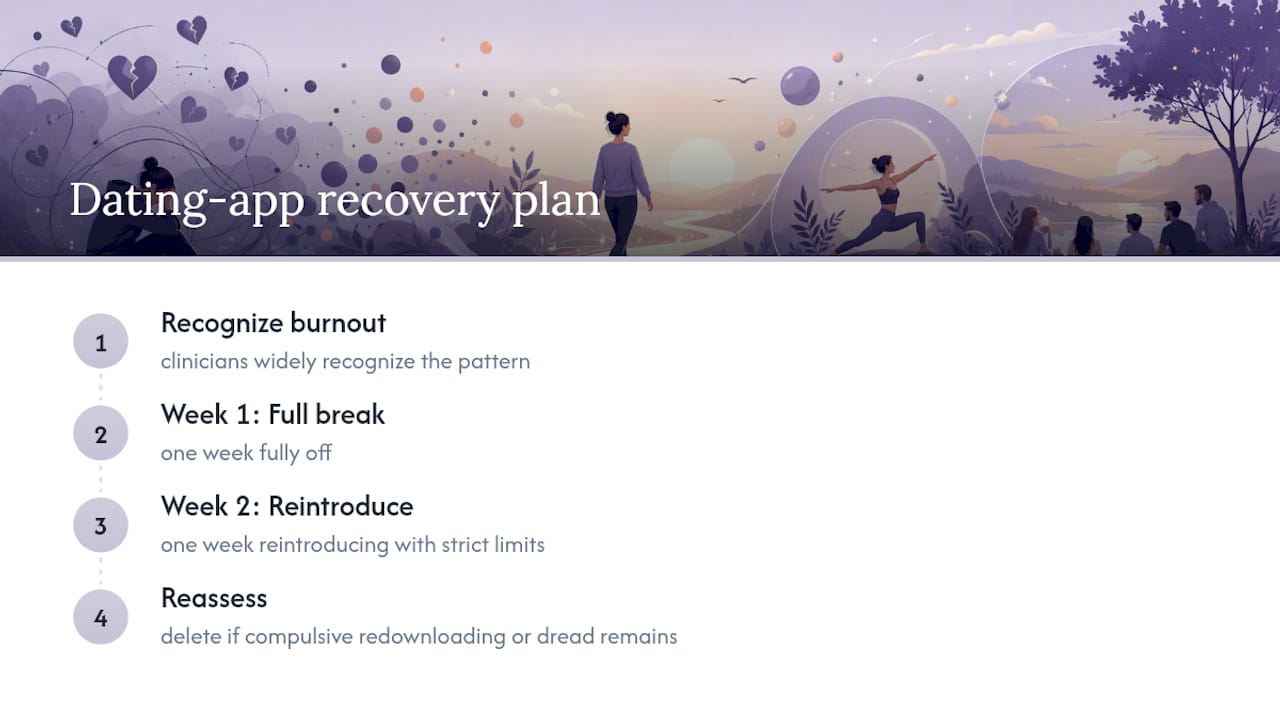
- Run a two-week recharge protocol. Week one: no apps at all. Week two: reintroduce with strict limits and a single, specific goal for each session (one meaningful conversation, not ten matches).
- Swipe with intention. Read the bio before you decide anything. If a profile gives you nothing to go on, skip it rather than guessing.
- Use a "weed-out" question early. Therapists sometimes recommend swiping more liberally, then asking a specific, slightly unusual question in the first message to force a real conversation and short-circuit the gamified snap-judging that makes matches feel disposable.
- Swap pure swiping for event-based or interest-based dating at least some of the time. Shared-activity settings, whether a hobby meetup or a game night, put context around the interaction instead of a blank profile grid.
Practical supports matter just as much as tactics. Tell a friend you're taking a break so they can check in. Schedule one real-world social activity a week, unrelated to dating, to rebuild the parts of your life that swiping crowded out. Join a hobby group or a themed singles event where the shared interest does some of the conversational work for you.
- Treat app use like social media: set frequency caps and firm time limits to avoid the dopamine loop.
- Draft two or three message templates in advance so you're not reinventing an opener every time, which is its own source of fatigue.
- Build a simple 7-day restart calendar: three low-pressure browsing days, two message days, two full days off.
Pro Tip: If you catch yourself swiping without reading anything, that's the gamification loop talking, not genuine interest. Close the app and come back only when you can commit to reading each profile.
How Do You Return to Dating Apps Without Burning Out Again?
Going back in cold is how most people relapse within a week. A short checklist before you reinstall anything saves you the second round of exhaustion.
Ask yourself honestly: Do I actually want this right now, or am I doing it out of habit? Do I have a specific purpose, casual connection, something serious, meeting new people, or am I just scrolling because I'm bored? Have I set a firm time rule I'll actually follow?
- Write a one-line purpose statement for why you're using the app this time.
- Set your weekly session cap before you log in, not after you're already three matches deep.
- Choose an app or format built around shared activity instead of a static photo grid. Platforms with in-chat icebreaker games, like the Duo Breakers built into Midnight Lobby's design for gamers, take the pressure off crafting a perfect opening line.
- Line up a swiping buddy, a friend who checks in on how the week went, and hold each other to the time limits.
- Watch for red flags that mean it's time to step back again: dread before opening the app, obsessive checking, or feeling worse after sessions than before.
Pro Tip: A written contract with yourself, even three lines in your notes app, works better than a vague intention. Specify the time limit, the weekly cap, and one thing you'll do instead when you hit it.
When Should You Get Professional Help for Dating App Fatigue?
Most burnout resolves with a break and some structural changes. Some cases need more.
Watch for persistent low mood that doesn't lift when you step away from the apps, anxiety that spikes around dating in general, self-blame that turns into "something is wrong with me," or social withdrawal that extends beyond dating into friendships and other relationships.
- Talk to a therapist if burnout symptoms last more than a few weeks despite a break.
- Consider a longer digital detox with clinician support if you notice compulsive use you can't control on your own.
- Reach out to a local crisis line if you're experiencing thoughts of self-harm or overwhelming hopelessness.
This pattern is common enough that clinicians treat it as a standard topic in therapy sessions, not an unusual complaint. You're not overreacting, and support is available.
A Human Perspective on Dating App Burnout
Wanting connection while feeling too drained to look for it is not a contradiction. It's exactly what prolonged exposure to a gamified, high-volume system does to anyone. The exhaustion is real, and so is the desire underneath it.
Small structural changes, a time limit, a break, a different format, restore more agency than people expect. You don't need to swear off dating forever. You need a system that doesn't run you into the ground. Try one change this week. If it's still too much, ask for help. Neither choice is a failure.
A Different Way to Meet People When Swiping Feels Exhausting
If decision fatigue and endless snap judgments are what's wearing you down, the fix isn't necessarily quitting dating apps. It's picking one that doesn't run on the same mechanics. Midnight Lobby matches gamers using the DuoFit compatibility system, which sorts people by shared gaming habits and schedules instead of asking you to make a snap call on a photo.
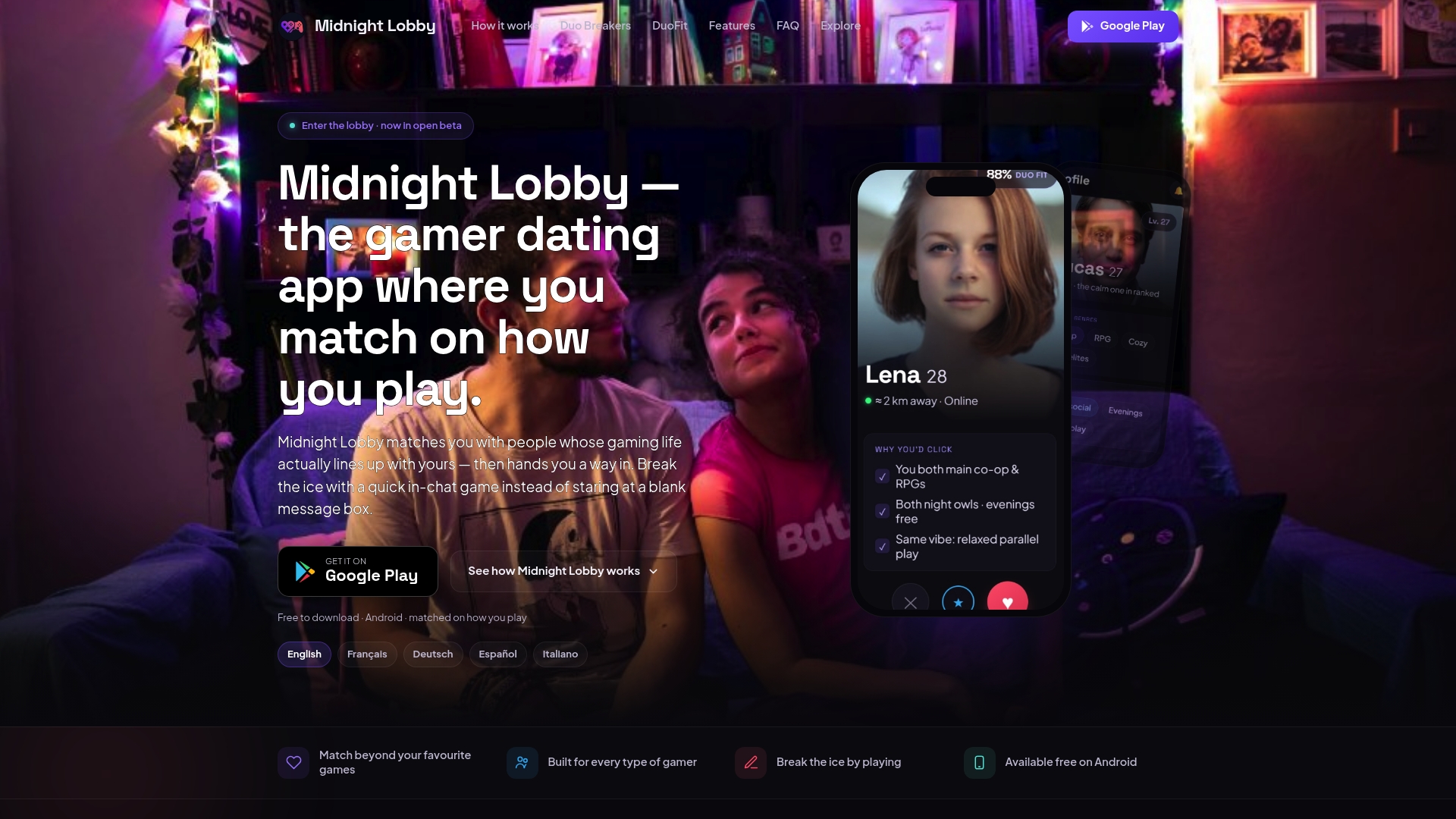
Two things change the experience directly. First, matching on gaming lifestyle means you're evaluating actual compatibility, not aesthetics, which cuts down the superficial judging that fuels burnout. Second, the in-chat Duo Breakers icebreaker games, think Draw & Guess or Hangman, remove the blank-page pressure of a first message, so conversations start as play instead of another decision to sort through.
If swiping fatigue has you avoiding dating apps altogether, this is worth trying as your reentry point. Download Midnight Lobby free on Android and set up a profile through the gamer dating guide to see how DuoFit matching feels different from a standard swipe deck.

Frequently Asked Questions
Is dating app burnout a real, recognized condition? It's not a formal clinical diagnosis, but clinicians widely recognize the pattern. Cleveland Clinic and AP News both document therapists routinely addressing it with clients who use dating apps.
How long does it take to recover from swipe fatigue? A two-week recharge protocol, one week fully off and one week reintroducing with strict limits, is enough for most people to notice a real shift in mood and motivation.
Do non-swipe dating apps actually reduce burnout? Formats built around shared interests or in-chat activities reduce the snap-judgment cycle that drives fatigue, since you're evaluating compatibility instead of making split-second visual calls.
What's the difference between normal dating tiredness and actual burnout? Tiredness passes after a short break. Burnout persists: dread before opening the app, numbness toward matches, and a nagging sense that nothing you try will work, even after rest.
Should I delete dating apps completely or just take a break? Start with a break of several days to two weeks. Full deletion makes sense if you notice compulsive redownloading or if a break doesn't reduce the dread and irritability.
This article is general information, not a substitute for advice from a qualified doctor. Consult a qualified healthcare professional about your own circumstances before acting on anything here.
Sources
- Are you stuck in the dating app burnout cycle?
- Are You Tired of Dating Apps? - Cleveland Clinic
- Dating app fatigue — Forbes Health
- PMC article (peer-reviewed) on digital relationship/dating health impacts
- Dating and relationships in the digital age - Pew Research Center